by Janis / 0 comments - Orginally published:31st January 2020
The final resting place of Brunel, Babbage and Blondin
Yes, you’re quite right — I’ve once again persuaded Gary to join me on a wander through another of London’s celebrated “Magnificent Seven” cemeteries, and this time our footsteps led us to Kensal Green Cemetery, in north-west London.
My fascination with these historic burial grounds shows no sign of fading. In fact, visiting in winter seems to heighten their atmosphere even further. Bare branches, low light and quiet paths lend an added sense of mystery, making the stories hidden here feel all the more powerful.
Kensal Green Cemetery lies alongside the Grand Union Canal and was originally known as the General Cemetery of All Souls. Consecrated in January 1833, it is the oldest of the Magnificent Seven, covering some 72 acres. Unlike many historic cemeteries, Kensal Green remains active today, continuing to conduct burials and cremations.

Why not Pin it for later?

Tomb of Major General Sir William Casement, K.C.B.
The cemetery was founded by the barrister George Frederick Carden, who drew inspiration from the garden cemetery of Père Lachaise in Paris — and yes, that’s one I’ve visited too.
Where is Kensal Green Cemetery?
How to get to Kensal Green Cemetery
- By Train
The nearest station to Kensal Green Cemetery is Kensal Green station. You can either take an overground service from London Euston (About 10 minutes.) Alternatively it's on the Bakerloo Line Underground.
Visiting Kensal Green Cemetery in Winter
A Winter Walk Through Twisting Ivy and TimeSo, on a cold Sunday morning in January, we wrapped up warm, laced up our comfy shoes, and set off in search of the quirky tales and heartfelt stories that lie quietly behind creeping ivy and leaning headstones.
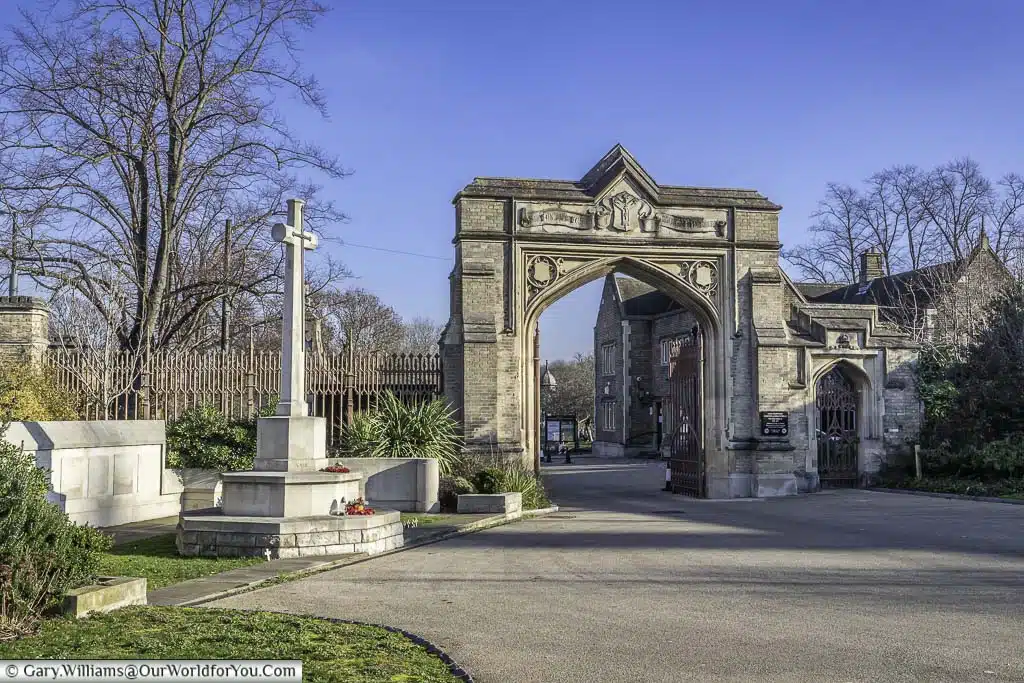
Passing through the Main Gate, Kensal Green immediately revealed the familiar character we’ve come to expect from the Magnificent Seven — a wonderfully unsymmetrical layout, where paths wander organically rather than following rigid lines.

Leaning graves

Snowdrops in January]
As we followed the main path alongside more recent burials, the soundscape shifted dramatically. High above us, green parakeets squawked loudly from the treetops — an unexpected and almost surreal presence.

The main path to the Anglican chapel
Yet, the deeper we ventured into the cemetery, the mood darkened. Ravens began swooping low across our path, perching on weathered headstones struggling under the weight of time. The parakeets disappeared entirely, only to reappear once we began heading back out again.
Stay informed
You will find us across many forms of social media. You will find our latest posts, some throwbacks, links to historic events with our 'On this day' posts, across Facebook, X, Bluesky & Threads. Each week, themed visual content on Instagram, and our narrated travels on YouTube. Collections of the images in our posts are also collated into boards on Pinterest.
The Brunel Family Grave
Engineering brilliance and Industrial Revolution legacyAmong the most visited graves at Kensal Green Cemetery is that of one of Britain’s greatest engineers, Isambard Kingdom Brunel. His name is synonymous with innovation, ambition, and the transformative power of the Industrial Revolution. Standing at his grave, it’s impossible not to reflect on just how profoundly Brunel shaped the modern world.
Isambard Kingdom Brunel followed in the formidable footsteps of his father, Sir Marc Isambard Brunel, who is also buried here in the same family plot. Marc Brunel was a brilliant engineer in his own right, best known for designing the Thames Tunnel, the first successful tunnel constructed beneath a navigable river. Together, father and son represent a remarkable engineering legacy that spans generations.

Isambard Kingdom Brunel and his father, Sir Marc Isambard Brunel
Brunel’s achievements were bold, often controversial, and always forward-thinking. He revolutionised transport infrastructure across Britain, designing railways, docks, tunnels, and bridges that pushed the boundaries of what was thought possible at the time. Among his most celebrated works is the SS Great Britain, the world’s first iron-hulled, screw-propelled ocean-going ship, now beautifully preserved as a museum in Bristol.
Equally iconic is the Clifton Suspension Bridge, a structure that has become one of Britain’s most recognisable landmarks. Although completed after his death, it stands as a lasting tribute to Brunel’s vision and engineering genius.
Despite his immense achievements, Brunel died relatively young, at just 53 years old, his health worn down by the relentless pace of his work. His burial at Kensal Green places him among fellow pioneers, innovators, and thinkers — a fitting resting place for a man who quite literally helped build modern Britain.
Standing here, amid the quiet of the cemetery, Brunel’s grave serves as a powerful reminder that many of the systems we rely on today — from rail travel to global shipping — trace their origins back to the ideas of one extraordinary engineer and the remarkable father who inspired him.
Commander Charles Spencer Ricketts: A Naval Life Begun at Seven
A Career Like No OtherOne of the most striking monuments at Kensal Green Cemetery is the beautifully detailed Grade II* listed tomb of Commander Charles Spencer Ricketts, designed by the renowned architect William Burges. Its ornate craftsmanship immediately draws the eye, hinting that the man commemorated here lived an extraordinary life.
Born in 1788, Charles Spencer Ricketts entered the Royal Navy at the astonishing age of just seven — a fact that feels almost unimaginable today. At a time when childhood was often brief and duty came early, Ricketts’ naval career unfolded against the backdrop of Britain’s expanding maritime power. He served aboard several vessels and saw active duty off the southern coast of Spain, experiencing conflict, hardship, and discipline from an age when most children were still firmly at home.

Commander Charles Spencer Ricketts, of the Royal Navy
Despite such an early and intense start, Ricketts’ career progressed rapidly. He rose through the ranks with distinction before retiring from active service at the remarkably young age of 27. Unlike many of his contemporaries, he survived the dangers of naval warfare and lived a long life, dying in 1867.
The tomb itself, restored with care in 2017, stands as both a memorial and a conversation piece. It reflects Victorian attitudes toward honour, service, and remembrance, while also prompting modern visitors to pause and consider how different life — and childhood — once was. Among the many stories scattered throughout Kensal Green, Ricketts’ stands out as a powerful reminder of duty undertaken long before adulthood truly began.
Andrew Ducrow’s Circus Crypt
Performance, spectacle and Egyptian revival symbolismOne of the most immediately eye-catching monuments at Kensal Green Cemetery is the crypt of Andrew Ducrow. Guarded by imposing Egyptian sphinx, the tomb perfectly reflects both Ducrow’s flamboyant career and the Victorian era’s fascination with exotic imagery and theatrical display..

Crypt of Andrew Ducrow, a British Circus performer

Egyptian sphinx guarding the tomb of Andrew Ducrow
Born in 1793, Andrew Ducrow was one of the most famous entertainers of his day and a central figure in the development of the modern circus. He was the owner and star attraction of Astley’s Amphitheatre, once London’s premier venue for equestrian performance and popular entertainment. Though the amphitheatre has long since disappeared, Ducrow’s influence on circus culture remains significant.
Ducrow is widely credited with pioneering equestrian circus acts, performing elaborate routines on horseback that combined athleticism, drama, and storytelling. His performances captivated audiences across London and beyond, including appearances in Covent Garden, and helped elevate circus entertainment from fairground novelty to theatrical art form.
Tragically, Ducrow’s life ended prematurely in 1842, reportedly following a decline in his mental health. His dramatic tomb, rich in symbolism, stands as a fitting tribute to a man whose life was lived in the spotlight. Today, it continues to draw visitors, offering a glimpse into the world of Victorian entertainment and reminding us that Kensal Green Cemetery is not only a place of mourning, but also a repository of extraordinary lives once lived to captivate and inspire.
Tightropes Across Niagara River
The Daring Feats of Charles BlondinThe unassuming crypt of Charles Blondin at Kensal Green Cemetery gives little hint of the extraordinary feats that made him one of the most famous performers of the 19th century. Born in 1824, Blondin was a French acrobat and tightrope-walker whose daring acts captured the imagination of audiences on both sides of the Atlantic.
Blondin achieved worldwide fame for his death-defying crossings of the Niagara Gorge in 1859, when he became the first person to walk a tightrope suspended high above the raging waters below. The feat alone would have been remarkable, but Blondin didn’t stop there. He repeated the crossing many times, deliberately increasing the danger by performing blindfolded, walking on stilts, pushing a wheelbarrow, carrying a man on his back, and even stopping mid-rope to cook and eat an omelette.

Charles Blondin (1824–1897), acrobat, tightrope-walker
These performances were not just acts of bravery but carefully choreographed spectacles that pushed the boundaries of human balance, nerve, and showmanship. Blondin’s mastery of his craft helped elevate tightrope walking from a novelty into a respected performance art, inspiring generations of acrobats and daredevils.
After retiring from the limelight, Blondin spent his later years in England, where he died in 1897. His final resting place at Kensal Green is a quiet contrast to the roaring crowds and thunderous waterfalls that once defined his life. Standing here, it’s astonishing to consider how a man who defied gravity and fear now lies beneath such a modest marker — another reminder that within Kensal Green Cemetery rest some of the most extraordinary stories ever lived.
Do you have a favourite cemetery?
Have you visited any unusual cemeteries around the world, I’d love you to share them with me? Please drop a comment below.
Charles Babbage
Computing innovation and a modest grave with global impactAlthough the grave of Charles Babbage at Kensal Green Cemetery is relatively modest, the impact of the man buried beneath it is anything but. Babbage was a mathematician, engineer, philosopher, and visionary whose ideas laid the foundations for the modern digital world we live in today.
Born in 1791, Babbage is best known for conceiving the Difference Engine and later the far more ambitious Analytical Engine—machines designed to perform complex calculations automatically. Although never fully built during his lifetime, the Analytical Engine is widely regarded as the first mechanical computer, incorporating concepts such as stored memory, conditional branching, and sequential processing—ideas that would not be realised in working machines for more than a century.

Charles Babbage grave in Kensal Green cemetery
What makes Babbage’s story particularly compelling is how far ahead of his time he truly was. His work was often misunderstood or underfunded, and he died without seeing his grand vision fully realised. Yet today, his influence is everywhere—from smartphones to space exploration—making his unassuming grave feel like a quiet resting place for one of history’s greatest innovators.
To explore Babbage’s legacy further, a visit to London’s Science Museum is well worth your time. Here, you can see working reconstructions of his engines and learn more about his groundbreaking ideas. For the less squeamish, the museum also displays half of Babbage’s preserved brain, offering a strangely fitting tribute to a man whose mind changed the course of history.
Standing at his grave, it’s impossible not to reflect on how many modern conveniences trace their origins back to Babbage’s imagination—a powerful reminder that some of the most world-changing figures leave behind the quietest memorials.
We have a little book on our shelves that we sometimes delve into when we're about to hit an area of London.
Packed full of historical facts, and broken down into the different regions of London, it's a great resource to help you see what's hidden in plain sight.
Available in Kindle & Hardback editions, it's an excellent addition to anyone's collection who loves London.

The Royals
Princes, lineage and monarchy within Kensal Green CemeteryYes — Kensal Green Cemetery is also the resting place of several members of the British royal family. The most notable is Prince Augustus Frederick, Duke of Sussex, who died in 1843.

The tomb of Prince Augustus Frederick, Duke of Sussex and son of King George III]
It may surprise some visitors, but Kensal Green Cemetery is the final resting place of several members of the British royal family. Unlike Westminster Abbey or St George’s Chapel at Windsor, Kensal Green offers a quieter, more reflective setting — one that feels fittingly understated.
One of the most notable royal burials here is Prince Augustus Frederick, Duke of Sussex, the sixth son of King George III, who died in 1843. A progressive and intellectually curious man, Prince Augustus was known for his support of liberal causes, his interest in science and literature, and his opposition to slavery. His tomb, while grand, blends seamlessly into the surrounding cemetery rather than dominating it.

Crypt of Princess Sophia

Mausoleum of Prince George, Duke of Cambridge
Nearby lies the crypt of his sister, Princess Sophia, another child of George III. Princess Sophia lived a long life but one largely overshadowed by duty and circumstance, spending much of it within the constraints placed on royal women of her era. Her burial at Kensal Green reinforces the cemetery’s role as a resting place not only for the powerful, but also for those whose personal stories were quieter and less celebrated.
Also interred within the cemetery is Prince George, Duke of Cambridge, a grandson of George III and Commander-in-Chief of the British Army. His mausoleum is one of the more imposing structures in this area, reflecting both his rank and the esteem in which he was held during his lifetime.
What’s particularly striking is how naturally these royal tombs sit among those of engineers, performers, military figures, and everyday Victorians. There is no sense of separation here — in death, royalty and commoner rest side by side, united by history rather than hierarchy. It’s a poignant reminder that Kensal Green Cemetery reflects the full breadth of British society, from palace to workshop, stage to battlefield.
Find out a little more
If you’d love to discover more about Kensal Green Cemetery take a look at the Friends of Kensal Green website.
The Friends of Kensal Green Cemetery also offer guided tours of the cemetery every Sunday from March to October. Then in November, December, January and February, it is the first and third Sunday.
War Graves
Remembrance, sacrifice and Commonwealth war memorialsScattered quietly throughout Kensal Green Cemetery are the graves of those who served and lost their lives during the First and Second World Wars. In total, the cemetery is the final resting place of 473 Commonwealth war graves from World War I and 51 from World War II — a sobering reminder of the global reach and human cost of conflict.
What feels particularly poignant here is that many of these graves are not gathered together in one single plot, as is often the case elsewhere, but are instead dispersed among family graves and civilian memorials. This scattering reinforces the idea that these men and women returned home to be laid to rest among loved ones, rather than in distant military cemeteries.

There Name Liveth for Evermore
Each headstone is immaculately cared for by the Commonwealth War Graves Commission, whose dedication ensures that every name is preserved with dignity and respect. The uniformity of the markers stands in gentle contrast to the ornate Victorian monuments around them, their simplicity lending a quiet gravity to the landscape.
Walking past these graves invites a moment of pause. Rank, background, and circumstance fade away, leaving only names, regiments, and dates — brief details hinting at lives cut short or forever altered by war. Within the calm of Kensal Green, these memorials serve as a powerful reminder that behind every conflict are individual stories of courage, loss, and sacrifice.
So many incredible stories
Listed structures, symbolism and Victorian commemorationWhat makes Kensal Green Cemetery so endlessly fascinating is the sheer number of stories contained within its grounds. Although it remains an active burial site today, the cemetery feels like an open-air archive of Victorian Britain, where history is preserved not in books, but in stone, sculpture, and symbolism.
As you wander through the cemetery, it quickly becomes apparent just how architecturally rich this place is. There are 153 Grade II* and Grade II listed structures, ranging from vast family mausoleums to delicately carved headstones, each reflecting the status, beliefs, and personal stories of those commemorated. Some monuments are grand and imposing, clearly designed to impress; others are quietly beautiful, their elegance revealed only to those who pause and look closely.

O’Brien family mausoleum

Robertson Aikman family crypt
Families such as the O’Brien and Robertson Aikman clans invested heavily in their memorials, commissioning elaborate crypts that resemble miniature temples or chapels. Elsewhere, you’ll find touching tributes marked by finely carved angels, symbolic flowers, and deeply personal inscriptions—small details that speak volumes about love, loss, and remembrance.
What’s particularly striking is the way nature has gradually reclaimed parts of the cemetery. Ivy creeps across stonework, moss softens sharp edges, and time has tilted many monuments at gentle angles. Rather than detracting from their beauty, this slow decay adds character, reinforcing the feeling that these stories are still alive, quietly unfolding as the years pass.

Beautiful honour after death

Elegant grave of Thea Canonero Altieri
Each path seems to reveal another chapter: artists and inventors, merchants and military figures, families who prospered and others whose fortunes faded. Together, they form a remarkable social tapestry—one that reflects the ambitions, beliefs, and realities of life in London across nearly two centuries.
Standing among these memorials, it becomes clear that Kensal Green is not just a cemetery, but a place of connection—where past lives continue to be acknowledged, remembered, and quietly honoured by those who take the time to explore.
Anglican Chapel & Catacombs
Faith, funerary architecture and hidden underground spacesStanding at the heart of Kensal Green Cemetery is the imposing Anglican Chapel, a structure that immediately commands attention despite its current state of decline. Built as part of the original 19th-century cemetery design, the chapel was once the spiritual focal point of Kensal Green, surrounded by an elegant colonnade that would have added a sense of grandeur and ceremony to funeral processions.
Today, the chapel awaits its long-overdue restoration, its weathered stonework hinting at former splendour. Even so, it’s easy to imagine how impressive it must have looked in its prime — a place where Victorian mourning rituals were carried out with formality, faith, and solemn dignity.

Anglian Chapel with the catacombs hidden below
Beneath the chapel lie the catacombs, now closed to the public and among the very few surviving catacombs in London. These underground chambers were once used to house coffins above ground level, reflecting Victorian concerns about burial practices, hygiene, and status. For many families, interment within the catacombs was seen as both prestigious and practical, offering a secure and permanent resting place.
Although inaccessible today, the presence of the catacombs adds an extra layer of intrigue to the site. Knowing that these hidden spaces exist just beneath your feet deepens the sense of history and quiet mystery that permeates Kensal Green. Together, the chapel and catacombs embody the cemetery’s original vision — not merely as a burial ground, but as a carefully planned landscape of remembrance, architecture, and reflection.
Kensal Green Crematorium & Gardens
Modern remembrance, notable cremations and peaceful reflectionAt the far end of Kensal Green cemetery are the crematorium and its beautifully kept tranquil gardens. Also, still used today and like the rest of the cemetery, utmost respect is expected here.
A few notable cremations that have taken place at Kensal Green over more recent years, and all of which have had their ashes taken care of privately. Are; Freddie Mercury, Alan Rickman, Ingrid Bergman, Christine Keeler, Joe Strummer and very recently Gary Rhodes.
RIP one and all.
Why not check out more of the Magnificent Seven
If Brompton Cemetery has sparked your curiosity, be sure to explore the other posts in our Magnificent Seven series. Each cemetery offers its own atmosphere, stories, and remarkable characters, from grand Victorian architecture to hidden corners reclaimed by nature. Follow along as we uncover the history, beauty, and quiet drama of London’s great garden cemeteries.


* This post may contain links to affiliated sites where we earn a small commission at no additional charge to you.
